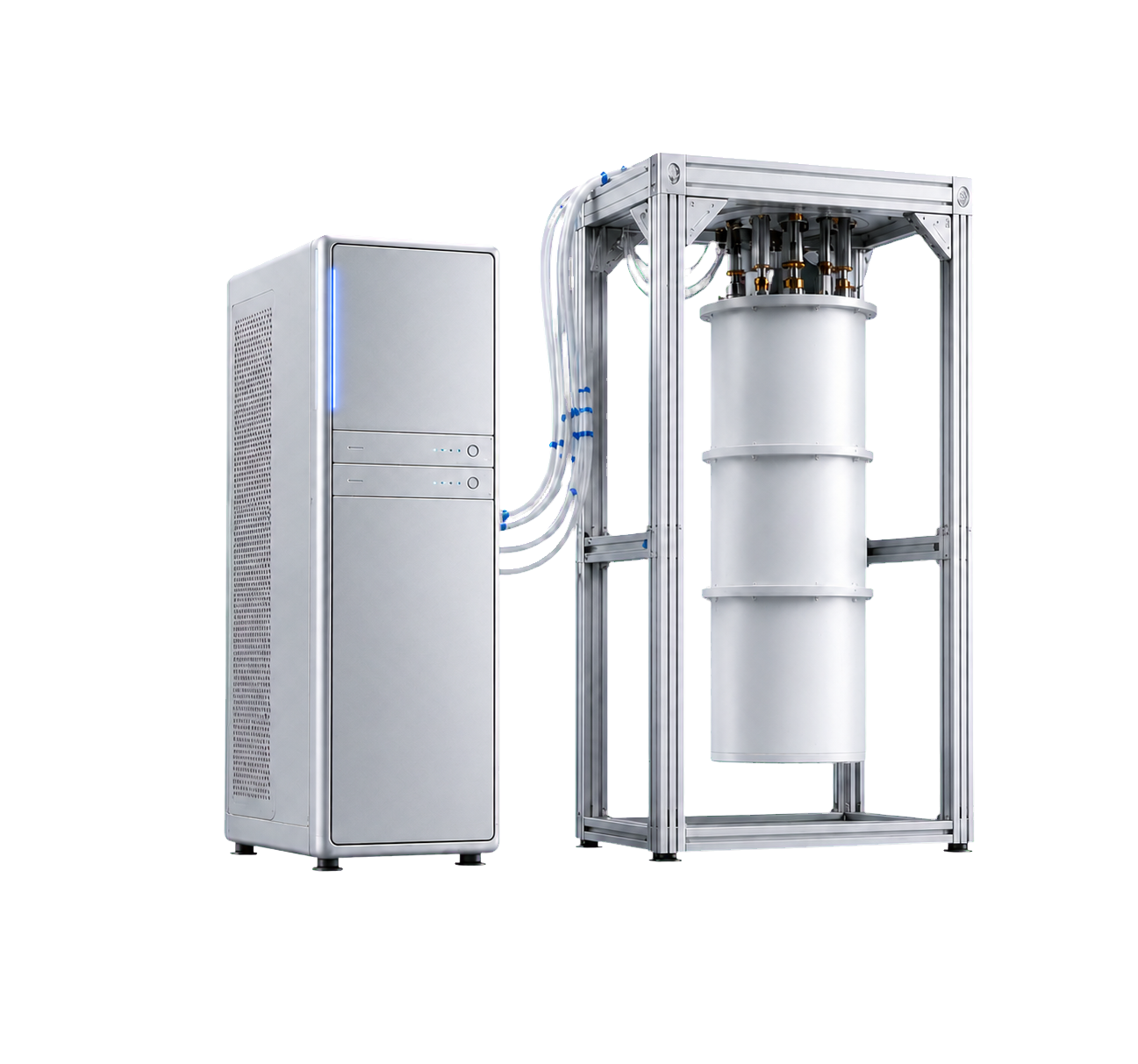
Built on a unified software interface, experimental workflow and control logic, the 5Q, 16Q and 64Q systems support open research, joint development and high-fidelity control experiments. Multiple superconducting modalities, including transmon and fluxonium, are supported alongside device validation, control capability development and joint incubation.
Linear 5Q Incubation System
A compact linear 5Q system for method validation, capability incubation and education.
- Linear 5Q architecture
- Low-barrier experiment iteration
- Capability building and method validation
L-5 supports small-scale method validation, team capability development and foundational teaching and research. It accelerates pulse design testing, device-readout integration, control electronics validation and basic experiment training while establishing transferable workflows for larger systems.
4×4 Grid Open Research System
A 4×4 grid / 16Q superconducting quantum computing system for two-dimensional scaling research, co-development and open experiments.
- 4×4 Grid architecture
- Open pulse-level control
- Two-dimensional scaling research
G-16 supports mid-scale method validation, training and two-dimensional scaling studies with low-level experimental control. Beyond circuit execution, it supports pulse definition, parameter sweeps, gate calibration, readout optimization and multi-run comparison for teams requiring stable operation and sustained joint R&D.
8×8 Grid Scalable System
An 8×8 grid / 64Q superconducting quantum computing system for large research platforms and system-level deployment.
- 8×8 Grid architecture
- Built for scaled systems
- System-level capability deployment
G-64 is designed for institutions and joint teams building large superconducting quantum computing platforms. It supports system control architecture, scaled experiment workflows, full-system deployment and future expansion—combining a higher qubit count with the engineering and operational foundations required for long-term platform development.